

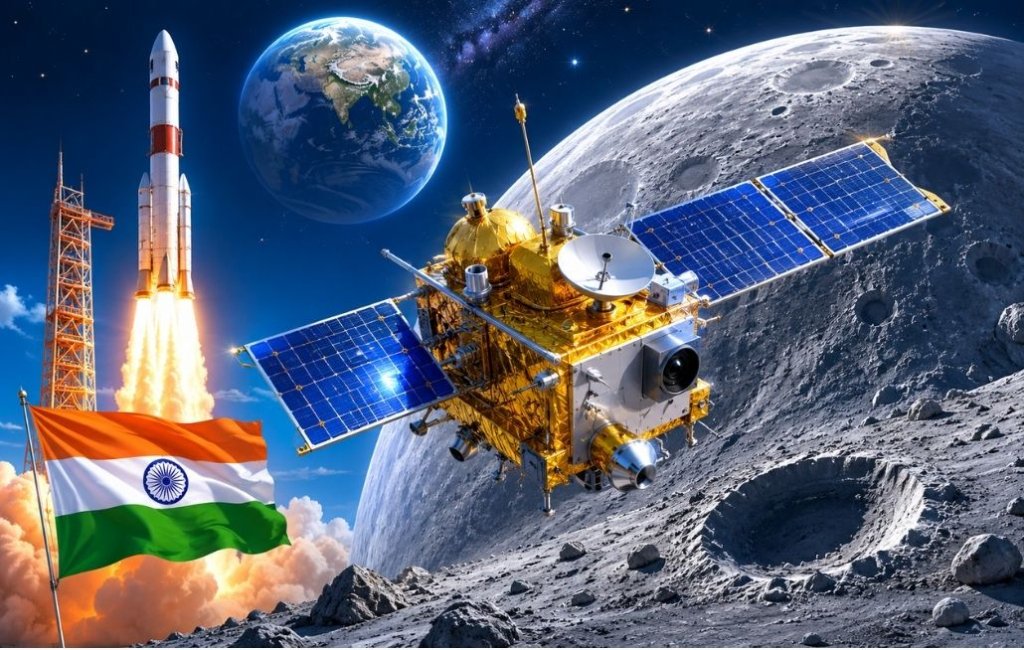
On October 22, 2008, India took a historic step in space exploration by launching Chandrayaan-1, the country’s first mission to the Moon. Developed by the Indian Space Research Organisation (ISRO), this mission was designed to study the Moon’s surface, understand its minerals, and search for important scientific clues.
Chandrayaan-1 became one of the most successful lunar missions in history when it helped confirm the presence of water molecules on the Moon’s surface. This discovery changed how scientists looked at the Moon and opened new possibilities for future lunar exploration.
| Mission Detail | Information |
|---|---|
| Mission Name | Chandrayaan-1 |
| Mission Type | Lunar Orbiter Mission |
| Developed By | Indian Space Research Organisation (ISRO) |
| Launch Date | October 22, 2008 |
| Launch Location | Satish Dhawan Space Centre, Sriharikota, India |
| Launch Vehicle | PSLV-C11 Rocket |
| Destination | Moon |
| Mission Objective | Study the Moon’s surface, minerals, and chemical composition |
| Spacecraft Weight | About 1,380 kg at launch |
| Lunar Orbit Reached | November 8, 2008 |
| Major Instrument | Moon Mineralogy Mapper (M³) |
| Historic Discovery | Confirmed water molecules on the Moon |
| Mission Duration | 312 days |
| Total Moon Orbits | More than 3,400 orbits |
| Mission Status | Successfully completed |
Chandrayaan-1 was India’s first step into deep space exploration. Although communication with the spacecraft ended earlier than planned, the mission achieved almost all of its scientific goals and became famous worldwide for helping discover water molecules on the Moon.
What Was Chandrayaan-1?
Chandrayaan-1 was India’s first lunar exploration mission designed to study the Moon from space. It was not a human mission or a Moon landing mission. Instead, it was an unmanned spacecraft that orbited around the Moon and collected important scientific information.
The name “Chandrayaan” comes from Sanskrit, where “Chandra” means Moon and “Yaan” means vehicle or craft. Together, Chandrayaan means “Moon Craft” or “Moon Vehicle.”
The spacecraft was developed by the Indian Space Research Organisation (ISRO) and carried advanced scientific instruments from India and other countries. These instruments helped scientists study the Moon’s surface, minerals, chemical elements, and signs of water molecules.
Key Things to Remember:
- Chandrayaan-1 was an unmanned Moon mission
- It studied the Moon by orbiting around it
- It carried scientific instruments, not astronauts
- It helped confirm the presence of water molecules on the Moon
- It marked India’s entry into deep space exploration
Chandrayaan-1 proved that a carefully designed robotic spacecraft could answer some of the biggest questions about our nearest celestial neighbour.
Why Did India Launch Chandrayaan-1?
For many years, scientists studied the Moon using telescopes and spacecraft, but there were still many unanswered questions about its surface, minerals, and history. India launched Chandrayaan-1 to better understand the Moon and contribute important discoveries to global space science.
The mission was designed to collect detailed information about the Moon from orbit using advanced scientific instruments. It helped researchers study the Moon’s surface, search for useful minerals, and understand how the Moon changed over billions of years. The main objectives of Chandrayaan-1 were:
Creating a Detailed Map of the Moon
Chandrayaan-1 captured high-resolution images of the lunar surface, helping scientists study mountains, craters, and different regions of the Moon.
Studying Minerals and Elements
The spacecraft studied the Moon’s surface materials to identify important minerals and chemical elements present on the Moon.
Searching for Signs of Water
One major goal was to search for water molecules that could support future lunar research and space exploration.
Advancing Space Technology
The mission helped India improve deep space communication, spacecraft control, and lunar mission technologies.
Supporting Global Space Research
Chandrayaan-1 carried international instruments, allowing scientists worldwide to learn more about the Moon together.
Understanding the Moon’s History
Chandrayaan-1 studied the Moon’s surface and composition to help scientists understand how the Moon formed and changed over billions of years.
Chandrayaan-1 was not only a mission to reach the Moon – it was a mission to understand Earth’s closest space neighbor and take India’s first major step into deep space exploration.
The Journey of Chandrayaan-1: From Earth to the Moon
Reaching the Moon requires much more than launching a spacecraft directly into space. Chandrayaan-1 followed a carefully planned journey where it first entered Earth’s orbit, gained the required speed, and then travelled towards the Moon using precise calculations by ISRO scientists.
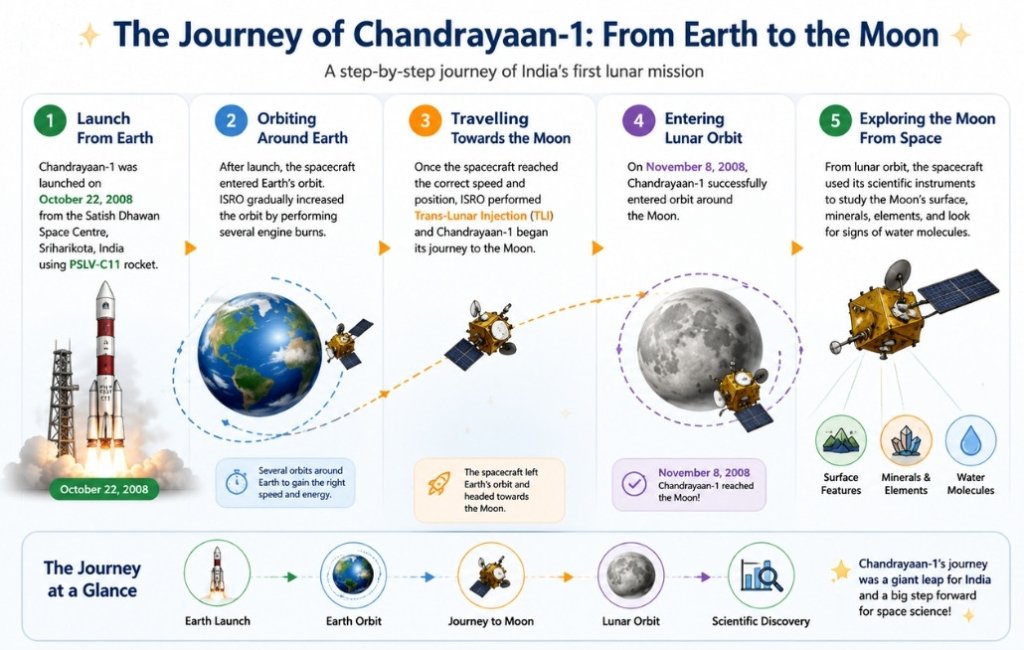
After travelling thousands of kilometers through space, Chandrayaan-1 successfully entered the Moon’s orbit on November 8, 2008. From there, it began studying the lunar surface, collecting scientific data, and searching for important clues that later helped confirm the presence of water molecules on the Moon.
Let’s understand the journey of Chandrayaan-1 step by step:
🚀 Step 1: Launch From Earth
Chandrayaan-1 began its journey on October 22, 2008, when it was launched from the Satish Dhawan Space Centre in Sriharikota, India.
The spacecraft was carried into space by the PSLV-C11 rocket, one of India’s reliable launch vehicles.
🌎 Step 2: Orbiting Around Earth
After launch, Chandrayaan-1 first entered an orbit around Earth.
Instead of going directly to the Moon, ISRO gradually increased the spacecraft’s orbit using planned engine burns. This helped Chandrayaan-1 gain enough energy for its journey toward the Moon.
🌕 Step 3: Travelling Towards the Moon
Once it reached the correct speed and position, Chandrayaan-1 left Earth’s orbit and started moving toward the Moon.
This important step is called the Trans-Lunar Injection, where a spacecraft begins its journey from Earth to lunar space.
🛰️ Step 4: Entering Lunar Orbit
On November 8, 2008, Chandrayaan-1 successfully entered orbit around the Moon.
The spacecraft started circling the Moon and preparing its scientific instruments for studying the lunar surface.
🔬 Step 5: Exploring the Moon From Space
From lunar orbit, Chandrayaan-1 collected valuable information about:
- Moon’s surface features
- Minerals and elements
- Chemical composition
- Possible signs of water molecules
The data collected during this journey helped scientists make one of the biggest discoveries in lunar science.
The Spacecraft Design: How Chandrayaan-1 Worked
Chandrayaan-1 was a robotic spacecraft designed to study the Moon from orbit. It was equipped with advanced technology that helped it travel through space, communicate with Earth, and collect scientific information about the lunar surface.
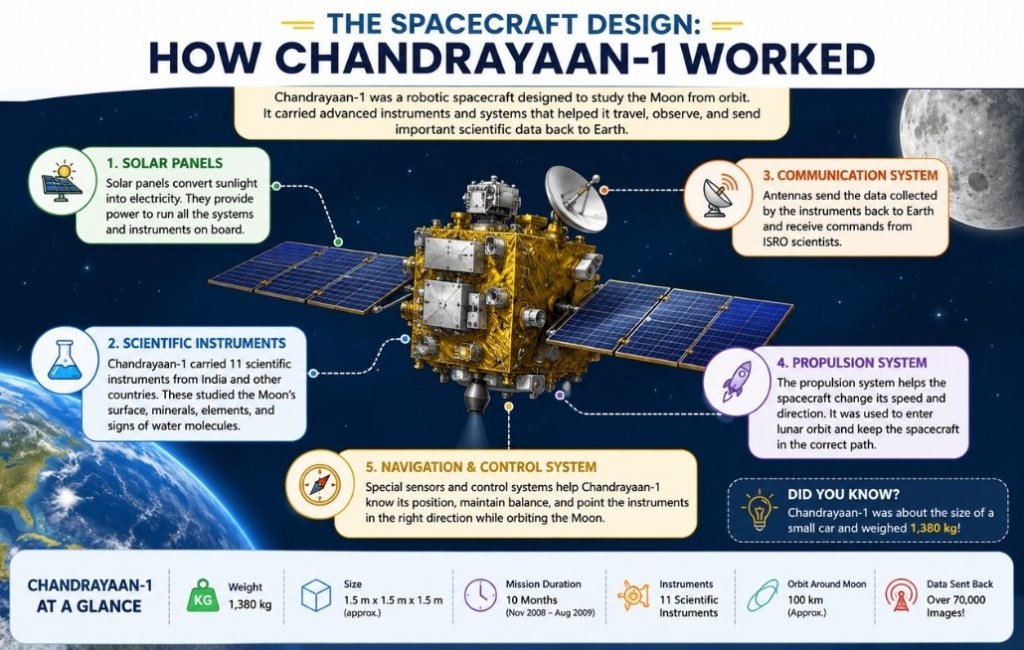
The spacecraft worked like a small space laboratory orbiting the Moon. Every part of Chandrayaan-1 had an important role, from generating power using sunlight to sending valuable data back to scientists on Earth.
Important Parts of Chandrayaan-1
- Solar Panels
Solar panels converted sunlight into electricity and provided power to operate the spacecraft’s systems and scientific instruments. - Scientific Instruments
Chandrayaan-1 carried multiple instruments that studied the Moon’s surface, minerals, chemical elements, and signs of water molecules. - Communication System
The spacecraft used antennas and communication equipment to send collected information back to Earth and receive instructions from ISRO. - Propulsion System
The propulsion system helped Chandrayaan-1 adjust its path, control its movement, and enter the correct orbit around the Moon. - Navigation and Control System
special sensors and control systems helped the spacecraft maintain the correct direction while travelling and orbiting in space.
Every part of Chandrayaan-1 worked together to make the mission successful. Its power, communication, navigation, and scientific systems helped the spacecraft travel through space, study the Moon from orbit, and send valuable information back to Earth, leading to important discoveries about the lunar surface and water molecules.
Scientific Instruments Carried by Chandrayaan-1
Chandrayaan-1 carried advanced scientific instruments called payloads. These instruments worked like the spacecraft’s eyes and sensors, helping scientists study the Moon’s surface, minerals, chemicals, and environment.
| Instrument | Developed By | Purpose |
|---|---|---|
| Terrain Mapping Camera (TMC) | India | Created detailed 3D maps of Moon |
| Moon Impact Probe (MIP) | India | Studied Moon while descending to surface |
| Moon Mineralogy Mapper (M³) | NASA | Studied minerals and detected water molecules |
| Mini-SAR | NASA | Searched for water ice in shadow regions |
| SARA | India & ESA | Studied interaction between Moon and solar particles |
The scientific instruments carried by Chandrayaan-1 transformed it into a powerful lunar research laboratory in space. These advanced tools helped scientists study the Moon in greater detail and played a key role in making groundbreaking discoveries, including the detection of water molecules on the lunar surface.
The Greatest Discovery: Water Molecules Found on the Moon
For many years, scientists believed that the Moon was a completely dry world. The lunar surface looked like a place filled only with rocks, dust, and craters, with almost no possibility of water existing there.
Chandrayaan-1 changed this understanding forever.
While orbiting around the Moon, Chandrayaan-1 collected important information about the lunar surface using its advanced scientific instruments. The data helped scientists confirm the presence of water molecules (H₂O) and hydroxyl molecules (OH) on parts of the Moon’s surface.
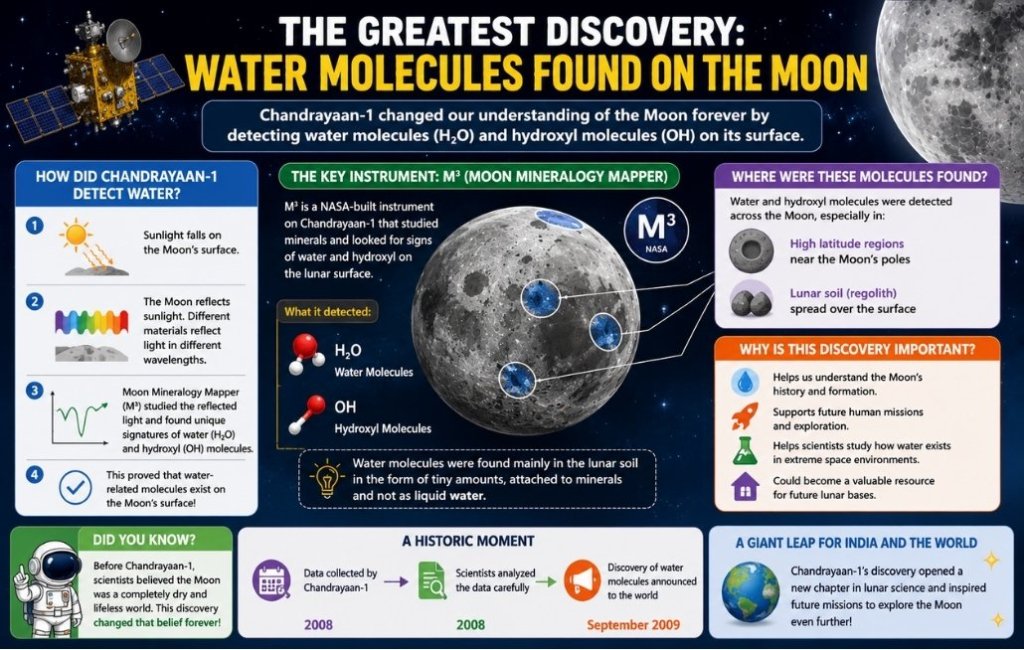
This discovery became one of the biggest achievements in lunar exploration history.
How Did Chandrayaan-1 Detect Water?
Chandrayaan-1 carried a scientific instrument called the Moon Mineralogy Mapper (M³), developed by NASA. This instrument studied sunlight reflected from the Moon’s surface.
Different materials absorb and reflect light in different ways. By studying these patterns, scientists found signals that matched water and hydroxyl molecules.
This proved that tiny amounts of water-related molecules existed on the Moon’s surface.
Did Chandrayaan-1 Find Lakes or Oceans on the Moon?
A common misunderstanding is that Chandrayaan-1 discovered flowing water, lakes, or oceans on the Moon.
However, the discovery was different.
Chandrayaan-1 found water molecules attached to lunar soil and minerals, not liquid water like we see on Earth.
Even this small discovery was extremely important because it showed that the Moon was not as dry as scientists once believed.
Why Was Finding Water on the Moon Important?
The discovery of water molecules opened new possibilities for future space missions.
Water on the Moon could help scientists:
- Understand the Moon’s history and formation
- Support future human exploration missions
- Study how water exists in extreme space environments
- Identify possible resources for future lunar bases
This discovery encouraged scientists around the world to study the Moon in a completely new way.
The discovery made by Chandrayaan-1 helped change the famous idea of the Moon from a “dry and lifeless world” to a place that still holds many scientific secrets waiting to be understood.
Why Was Chandrayaan-1 a Historic Mission?
Chandrayaan-1 was not just India’s first mission to the Moon-it became a turning point in the country’s journey into deep space exploration. The mission demonstrated that ISRO could successfully design, launch, and operate a spacecraft far beyond Earth while contributing valuable discoveries to global lunar research.
Its success strengthened India’s position among the world’s leading space-faring nations and laid the scientific and technological foundation for future missions. Even years after its launch, Chandrayaan-1 continues to influence lunar exploration and inspire the next generation of scientists and engineers.
India’s First Lunar Mission
Chandrayaan-1 made India the fourth country to successfully send a spacecraft to the Moon, marking a historic milestone in the nation’s space journey.
Global Scientific Recognition
The mission earned worldwide recognition by contributing valuable lunar data that was used by scientists and research organizations across the globe.
Changed Lunar Science
Its discovery of water molecules transformed scientific understanding of the Moon and encouraged new research into future lunar exploration.
Advanced India’s Technology
The mission improved India’s capabilities in deep-space communication, spacecraft navigation, mission planning, and lunar exploration technologies.
Foundation for Future Missions
The knowledge gained from Chandrayaan-1 directly supported the planning and success of Chandrayaan-2, Chandrayaan-3, and future ISRO missions.
Inspired Future Generations
Chandrayaan-1 inspired millions of students to learn about science, engineering, and space technology while encouraging innovation across India.
Chandrayaan-1 proved that a single mission can achieve much more than its original goals. Beyond its scientific discoveries, it strengthened India’s space capabilities, inspired future lunar missions, and established ISRO as a trusted leader in global space exploration-leaving a legacy that continues to shape the future of space science.
FAQ About Chandrayaan-1
1. What does the name “Chandrayaan” mean?
The word “Chandrayaan” comes from Sanskrit, where “Chandra” means Moon and “Yaan” means vehicle or craft. Together, Chandrayaan means “Moon Craft” or “Moon Vehicle.”
2. How far did Chandrayaan-1 travel to reach the Moon?
The average distance between Earth and the Moon is about 384,400 kilometres (238,855 miles). Chandrayaan-1 reached the Moon after following a carefully planned orbital path rather than travelling in a straight line.
3. Why didn’t Chandrayaan-1 fly directly to the Moon?
Instead of flying straight to the Moon, Chandrayaan-1 first orbited Earth several times. ISRO gradually increased its orbit to build enough speed before sending it toward the Moon. This method required less fuel and made the mission more efficient.
4. What is a lunar orbiter?
A lunar orbiter is a spacecraft that circles the Moon without landing on it. It studies the Moon from space by taking pictures, collecting scientific data, and sending the information back to Earth.
5. Who controlled Chandrayaan-1 after its launch?
After launch, Chandrayaan-1 was continuously monitored and controlled by scientists and engineers at ISRO’s mission control centres. They guided the spacecraft, monitored its health, and received scientific data throughout the mission.
6. Did Chandrayaan-1 carry astronauts?
No. Chandrayaan-1 was a completely unmanned robotic mission. It carried scientific instruments instead of astronauts, allowing it to safely study the Moon without human intervention.
7. Can scientists still use the data collected by Chandrayaan-1?
Yes. Even though the mission ended in 2009, the data collected by Chandrayaan-1 is still used by scientists and researchers to study the Moon and support future lunar missions.
8. Why is the Moon an important place for future space missions?
The Moon can serve as a testing ground for future missions to Mars and beyond. Scientists are studying its resources, including water ice, because they could help support long-term human exploration and space habitats.
9. What happened to Chandrayaan-1 after the mission ended?
Communication with Chandrayaan-1 was lost on August 29, 2009. Although the mission ended earlier than planned, it had already completed most of its scientific objectives and was declared a major success by ISRO.
10. How did Chandrayaan-1 inspire future generations?
Chandrayaan-1 became a symbol of scientific achievement in India. It inspired millions of students to learn about science, engineering, astronomy, and space technology while encouraging young minds to dream of careers in space exploration.
Final Thought
Chandrayaan-1 was a landmark mission that placed India among the world’s leading space-faring nations. Its groundbreaking discoveries, advanced technology, and successful exploration of the Moon expanded our understanding of lunar science and laid the foundation for future missions like Chandrayaan-2 and Chandrayaan-3. More than just a scientific achievement, Chandrayaan-1 continues to inspire young minds to dream big, stay curious, and shape the future of space exploration.