



Understanding Your Child’s Changing Needs
Every age brings new interests, abilities, and ways of learning. Knowing what generally changes as children grow can help you choose experiences that feel engaging without putting unnecessary pressure on them.
Skills Change With Age
Young children often learn through repetition and hands-on play, while older children may enjoy challenges that involve planning, problem-solving, and greater independence.
Interests Guide Learning
Age matters, but your child’s interests matter too. Animals, stories, drawing, building, vehicles, science, and imaginative play can all become meaningful ways to support learning.
Progress Looks Different
Children do not all develop at exactly the same pace. Use age ranges as helpful guidance, then pay attention to your child’s comfort, confidence, interests, and readiness.
Find Something Meaningful for Their Next Stage
Browse books, creative activities, toys, and learning products made for growing minds.
Ages 3–4: Learning Through Play and Discovery
At this stage, children are building confidence through simple routines, conversation, movement, creative play, and hands-on experiences.
- Encourage counting, sorting, matching, and recognizing simple patterns.
- Read short stories together and talk about pictures, characters, and feelings.
- Offer crayons, coloring activities, blocks, puzzles, and simple creative projects.
- Give children small choices so they can practise making decisions independently.
- Repeat favorite activities while gradually introducing one new challenge at a time.
Keep activities short, playful, and flexible. At this age, curiosity and participation are often more important than getting the “right” answer.

Make Everyday Play Part of Their Learning
Choose simple, age-appropriate products that encourage curiosity and creativity.
Ages 5–8: Building Skills, Confidence, and Curiosity
As children become more independent, activities can gradually invite them to think, create, solve problems, and explain their ideas.
Practise and Create
Children can begin connecting letters, numbers, stories, art, and everyday experiences. Give them opportunities to complete simple tasks independently while staying available when they need help.
Question and Solve
Encourage children to ask questions, explain how they reached an answer, follow multi-step activities, and try different ways of solving a problem. Games and creative challenges can make this especially engaging.
Think and Build
Children may enjoy projects that require planning, reading instructions, creating something of their own, or applying what they already know to a new challenge.
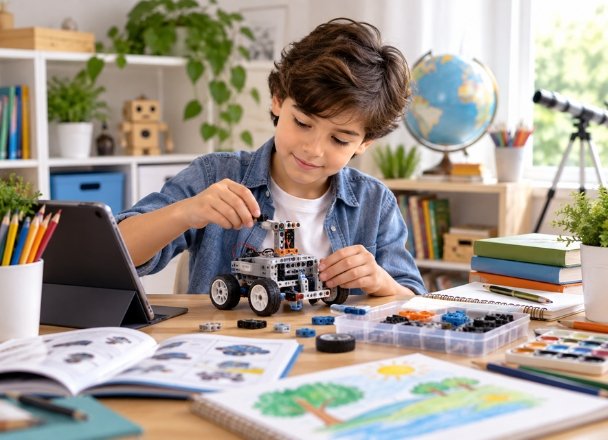
Ages 8+: Encourage Independence and Deeper Thinking
As children grow, they can take greater ownership of what they learn and how they spend their creative time.
- Offer projects that involve planning, research, creativity, or problem-solving.
- Encourage children to explain their choices instead of simply giving them answers.
- Let them choose activities that connect with their personal interests.
- Introduce longer projects that can be completed over several sessions.
- Encourage reflection by asking what they enjoyed, learned, or would change next time.
The goal is not to make every activity harder. It is to give children more opportunities to make decisions, stay curious, and feel proud of what they can accomplish.
Give Growing Minds More Ways to Learn and Create
Find products and activities that can support your child’s changing interests and abilities.
Choose What Fits Your Child, Not Just Their Age
Age ranges are useful starting points, but the best learning experiences also reflect a child’s interests, confidence, abilities, and readiness.
Two children of the same age can enjoy completely different activities. One may love drawing and storytelling, while another may prefer building, sorting, puzzles, or movement. Following those interests can make learning feel natural rather than forced.
Pay attention to how your child responds to an activity. If they are curious and eager to continue, you may be able to add another small challenge. If they become frustrated, simplify the task or return to something familiar.
The right activity should provide enough challenge to keep children interested without making them feel overwhelmed. Small successes can build confidence and encourage them to try something new.
Variety also matters. Reading can support language, creative activities can strengthen fine-motor practice, games can encourage problem-solving, and hands-on play can help children understand ideas through experience.
Most importantly, leave room for children to make choices. Let them decide what to create, which color to use, which story to read, or how they want to solve a simple challenge. These small decisions can make an activity feel personal and meaningful.
Think of age-by-age guidance as a helpful map, not a strict checklist. Your child’s individual interests and growing abilities should always help guide what comes next.
Age-by-Age Guides: Frequently Asked Questions
Here are answers to some common questions parents have when choosing learning and play activities for children at different ages.
Why are age ranges important when choosing activities for children?
Age ranges can give parents a useful starting point because children’s interests, abilities, and independence often change as they grow. They should be used as general guidance rather than a strict measure of what every child should be able to do.
What activities are suitable for children ages 3–4?
Simple storytelling, coloring, matching games, counting activities, puzzles, building, pretend play, and hands-on creative activities can work well for this age. Keep activities playful and allow children to participate at their own pace.
How can I make learning activities more enjoyable for my child?
Start with your child’s interests. If they enjoy animals, use animal stories, pictures, counting games, or creative projects. Give them choices, ask questions, and allow them to experiment rather than focusing only on getting the correct answer.
Should children of the same age do the same activities?
Not necessarily. Children develop different interests and skills at different rates. An age guide can help you choose an appropriate starting point, but your child’s readiness, confidence, and interests should also influence the activity you choose.
How do I know if an activity is too easy or too difficult?
Watch how your child responds. If they finish immediately and want more, you can add a small challenge. If they become frustrated or lose interest, simplify the activity, offer help, or try something familiar before increasing the difficulty.
How can I support my child’s learning without making it feel like school?
Use everyday experiences as learning opportunities. Read together, count objects, cook, draw, build, play games, ask questions, and talk about what your child notices. Learning can happen naturally through play and conversation.
Should I choose educational products based only on age?
Age is useful, but it should not be the only consideration. Look at your child’s interests, abilities, confidence, and the type of experience the product offers. A good choice should feel appropriate while giving your child room to learn, create, and enjoy the activity.
How often should I introduce new learning activities?
There is no need to introduce something new every day. Children often benefit from repeating activities they enjoy while making small changes over time. Repetition can build familiarity and confidence, while occasional new experiences keep curiosity growing.
Find the Next Activity Your Child Will Love
Browse KidzNCrew products designed to make learning, creativity, and play meaningful.