
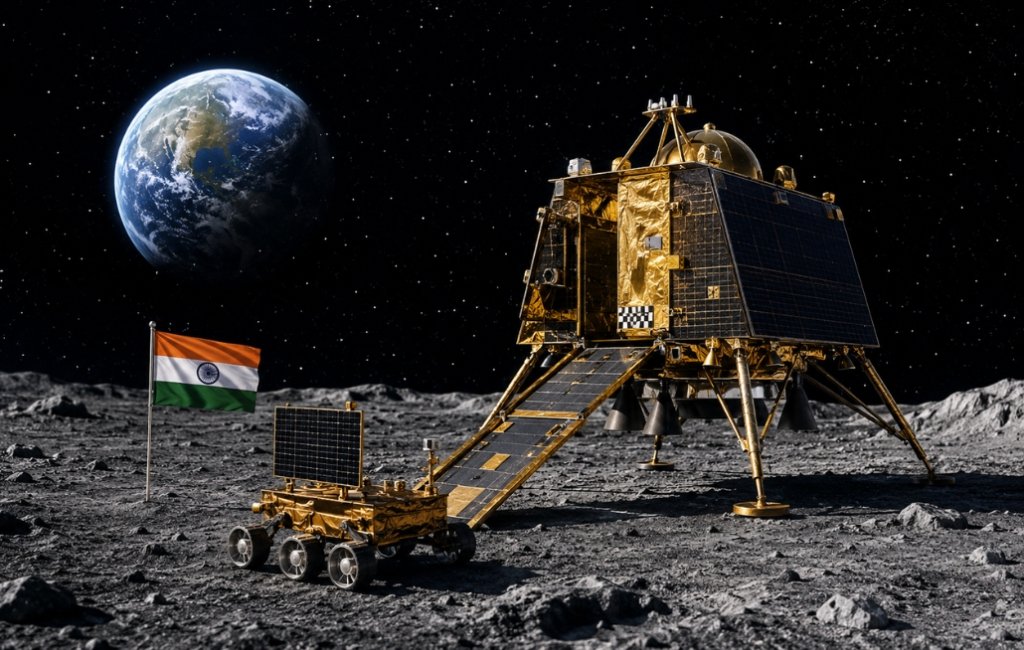
Chandrayaan-3 is one of India’s greatest achievements in space exploration. Launched by the Indian Space Research Organisation (ISRO) on July 14, 2023, the mission made history by successfully achieving a soft landing near the Moon’s South Polar region on August 23, 2023. With this remarkable accomplishment, India became the first country to land near the Moon’s South Pole and the fourth nation in the world to achieve a successful soft landing on the Moon, joining the United States, the former Soviet Union, and China.
Unlike Chandrayaan-2, which faced challenges during its landing attempt, Chandrayaan-3 was carefully designed using the valuable lessons learned from the previous mission. Equipped with the Vikram Lander and Pragyan Rover, the mission successfully conducted scientific experiments, studied the Moon’s surface, and provided important information about one of the least explored regions of the Moon.
| Mission Detail | Mission Detail |
|---|---|
| Mission Name | Chandrayaan-3 |
| Mission Type | Lunar Lander and Rover Mission |
| Developed By | Indian Space Research Organisation (ISRO) |
| Launch Date | July 14, 2023 |
| Launch Location | Satish Dhawan Space Centre, Sriharikota, India |
| Launch Vehicle | LVM3-M4 Rocket |
| Mission Cost | Approximately ₹615 Crore (US$75 Million) |
| Mission Objective | Achieve a soft landing, deploy a rover, and conduct scientific experiments on the Moon |
| Destination | Moon’s South Polar Region |
| Spacecraft Modules | Propulsion Module, Vikram Lander, and Pragyan Rover |
| Total Launch Mass | About 3,900 kg |
| Lunar Orbit Reached | August 5, 2023 |
| Lander Separation | August 17, 2023 |
| Soft Landing Date | August 23, 2023 |
| Landing Site | Shiv Shakti Point, Moon’s South Polar Region |
| Lander Name | Vikram |
| Rover Name | Pragyan |
| Mission Duration | About 40 days (Launch to Landing) |
| Mission Life (Lander & Rover) | One Lunar Day (About 14 Earth Days) |
| Major Scientific Instruments | ChaSTE, ILSA, RAMBHA-LP, LIBS, APXS, SHAPE |
| Primary Scientific Goal | Study the Moon’s surface, temperature, seismic activity, plasma environment, and elemental composition |
| Historic Achievement | First country to successfully land near the Moon’s South Pole |
| Global Milestone | Fourth nation to achieve a successful soft landing on the Moon |
| Mission Status | Successfully Completed |
| Significance | Marked India’s successful lunar landing and advanced lunar exploration capabilities |
In this guide, you’ll learn everything about Chandrayaan-3, including why it was launched, its mission objectives, how it reached the Moon, the technology behind its historic landing, the discoveries made by the Vikram Lander and Pragyan Rover, and why this mission is considered a major milestone in India’s space journey. Whether you’re a student, teacher, or space enthusiast, this article will help you understand Chandrayaan-3 in a simple, engaging, and informative way.
please make this section informative, presentative, and readable.
I think we should avoid making this section another long explanation. Instead, let’s make it visually engaging and easy to skim, just as we did in the previous two blogs.
What Is Chandrayaan-3?
Chandrayaan-3 is India’s third lunar exploration mission, developed by the Indian Space Research Organisation (ISRO). Launched on July 14, 2023, the mission was designed to demonstrate a safe and successful soft landing on the Moon and deploy the Pragyan Rover to carry out scientific experiments near the Moon’s South Polar region.
Unlike Chandrayaan-2, Chandrayaan-3 did not include a dedicated Orbiter. Instead, it consisted of a Propulsion Module, the Vikram Lander, and the Pragyan Rover. Using the valuable lessons learned from Chandrayaan-2, ISRO improved the spacecraft’s landing technology, navigation system, and safety features, making the mission more reliable and capable of handling unexpected situations during its final descent.
Key Things to Remember About Chandrayaan-3:
- India became the first country to successfully land near the Moon’s South Polar region.
- Chandrayaan-3 achieved a successful soft landing on August 23, 2023.
- The Pragyan Rover explored the lunar surface and performed scientific experiments.
- The mission studied the Moon’s temperature, seismic activity, plasma environment, and surface composition.
- India became the fourth nation to achieve a successful soft landing on the Moon.
- The mission proved ISRO’s advanced landing technology and strengthened India’s position in global space exploration.
Why Is Chandrayaan-3 Important?
Chandrayaan-3 was much more than a successful Moon mission. It demonstrated India’s ability to perform complex lunar landings, conduct scientific research on the Moon’s surface, and overcome the challenges faced during Chandrayaan-2. The mission marked a historic milestone for ISRO and inspired millions of people around the world, proving that continuous learning, innovation, and determination can lead to extraordinary achievements in space exploration.
Why Did ISRO Launch Chandrayaan-3?
After the valuable lessons learned from Chandrayaan-2, ISRO launched Chandrayaan-3 to demonstrate that India could successfully achieve a soft landing on the Moon. The mission was carefully designed to improve landing technology, validate advanced spacecraft systems, and continue exploring the Moon’s South Polar region. Beyond achieving a historic milestone, Chandrayaan-3 aimed to expand scientific knowledge and strengthen India’s position in global space exploration.
Soft Landing
Demonstrate India’s ability to achieve a safe and controlled soft landing on the Moon.
Rover Deployment
Successfully deploy the Pragyan Rover to explore the lunar surface and perform scientific experiments.
Test Technology
Validate improved landing, navigation, communication, and hazard detection technologies.
Scientific Research
Study the Moon’s surface, temperature, seismic activity, plasma environment, and elemental composition.
Explore South Pole
Investigate one of the Moon’s least explored regions for valuable scientific insights.
Advance Space Program
Strengthen India’s leadership in lunar exploration and prepare for future space missions.
Chandrayaan-3 was launched with a clear mission: to achieve what no Indian spacecraft had done before – a successful soft landing on the Moon. By combining advanced technology with the experience gained from Chandrayaan-2, ISRO not only accomplished this goal but also opened a new chapter in India’s space journey. The mission demonstrated that perseverance, innovation, and continuous improvement can transform challenges into historic achievements.
What Were the Mission Objectives of Chandrayaan-3?
Chandrayaan-3 was designed with a clear set of scientific and technological objectives that would help India achieve a successful lunar landing and continue exploring the Moon. Building on the experience gained from Chandrayaan-2, the mission focused on demonstrating advanced landing capabilities while carrying out important experiments on the lunar surface.
🌕 Soft Landing
Safely land the Vikram Lander near the Moon’s South Polar region and demonstrate a controlled soft landing.
🤖 Rover Operations
Deploy the Pragyan Rover to move across the lunar surface and conduct scientific experiments.
🛰️ Landing Technology
Validate improved landing, navigation, guidance, and hazard detection systems for future missions.
🔬 Surface Experiments
Study the Moon’s temperature, seismic activity, plasma environment, and elemental composition.
📍 South Pole Research
Explore the Moon’s South Polar region, one of the least explored areas with high scientific importance.
🚀 Future Missions
Strengthen India’s capabilities in lunar exploration and prepare for more advanced missions, including human spaceflight and future planetary exploration.
The objectives of Chandrayaan-3 went beyond achieving a successful Moon landing. The mission demonstrated India’s growing expertise in space technology, expanded scientific knowledge about the lunar environment, and established a strong foundation for future space exploration. Its success marked a significant milestone in ISRO’s journey toward more ambitious missions beyond the Moon.
How Did Chandrayaan-3 Reach the Moon?
Reaching the Moon requires careful planning, precise navigation, and a series of complex orbital maneuvers. Instead of traveling directly to the Moon, Chandrayaan-3 gradually increased its orbit around Earth before beginning its journey into deep space. After several weeks of travel and orbital adjustments, the spacecraft successfully entered lunar orbit and prepared for its historic landing near the Moon’s South Polar region.
Follow the mission timeline below to understand how Chandrayaan-3 traveled from Earth to the Moon.
Chandrayaan-3 was launched aboard the LVM3-M4 rocket from the Satish Dhawan Space Centre in Sriharikota, India.
The spacecraft completed multiple Earth orbits while gradually increasing its altitude before escaping Earth’s gravity.
ISRO carried out the Trans-Lunar Injection (TLI) maneuver, sending Chandrayaan-3 on its journey toward the Moon.
The spacecraft successfully entered lunar orbit and performed a series of orbit-lowering maneuvers to prepare for landing.
The Vikram Lander separated from the Propulsion Module and began its independent journey toward the lunar surface.
Vikram successfully achieved a controlled soft landing near the Moon’s South Polar region, making India the first country to land in this area and the fourth nation to achieve a soft landing on the Moon.
The Pragyan Rover rolled onto the lunar surface and conducted scientific experiments, studying the Moon’s composition, temperature, and environment before completing its mission.
The journey of Chandrayaan-3 showcased ISRO’s exceptional expertise in deep-space navigation, spacecraft control, and lunar landing technology. Every stage of the mission was executed with remarkable precision, culminating in a historic soft landing that established India as a global leader in lunar exploration and inspired millions around the world.
How Did Chandrayaan-3 Successfully Land on the Moon?
Landing on the Moon is one of the most challenging tasks in space exploration. Unlike Earth, the Moon has no atmosphere to slow down a spacecraft using parachutes. Every stage of the descent must be controlled using onboard computers, sensors, cameras, and rocket engines.
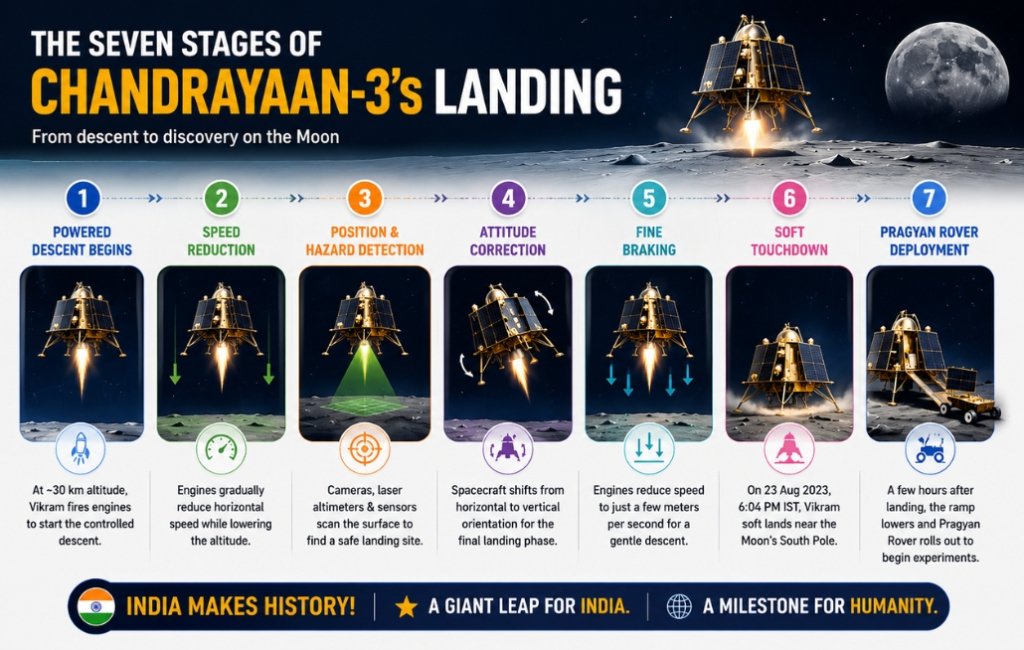
For Chandrayaan-3, ISRO used improved landing technology and the lessons learned from Chandrayaan-2 to achieve a safe and successful soft landing near the Moon’s South Polar region.
Key Technologies That Made the Landing Successful
| Technology | Purpose |
|---|---|
| 🛰️ Laser Altimeter | Measured the lander’s altitude above the lunar surface |
| 📷 Hazard Detection Cameras | Identified a safe landing area by detecting obstacles |
| 📡 Laser Doppler Velocimeter | Measured the spacecraft’s speed during descent |
| 🧠 Autonomous Navigation | Allowed the onboard computer to make real-time landing decisions |
| 🚀 Throttleable Engines | Controlled speed and direction for a smooth landing |
| ⚙️ Improved Landing Legs | Absorbed impact and ensured a stable touchdown |
The successful landing of Chandrayaan-3 was the result of years of engineering, testing, and continuous improvement. By combining advanced landing technologies with the valuable lessons learned from Chandrayaan-2, ISRO achieved one of the greatest milestones in India’s space history. This historic accomplishment not only demonstrated India’s technological excellence but also opened new opportunities for future lunar and planetary exploration.
Vikram Lander and Pragyan Rover: How Did They Work?
Chandrayaan-3 consisted of three major components: the Propulsion Module, the Vikram Lander, and the Pragyan Rover. Each had a specific role in ensuring the mission’s success. While the Propulsion Module carried the spacecraft to lunar orbit, the Vikram Lander achieved the historic soft landing, and the Pragyan Rover explored the Moon’s surface to perform scientific experiments.
Mission Components at a Glance
| 🛰️ Propulsion Module | 🌕 Vikram Lander | 🤖 Pragyan Rover |
|---|---|---|
| Carried the lander from Earth to lunar orbit. | Performed the historic soft landing near the Moon’s South Pole. | Explored the lunar surface after deployment. |
| Separated from Vikram before landing. | Used advanced sensors and engines for autonomous landing. | Moved on six wheels using solar power. |
| Conducted the SHAPE experiment while orbiting the Moon. | Measured temperature, seismic activity, and plasma around the landing site. | Analyzed rocks and soil using LIBS and APXS instruments. |
| Continued operating in lunar orbit after separation. | Acted as a communication link for the rover. | Sent scientific findings to Vikram for transmission to Earth. |
How They Worked Together
🚀 Launch
│
▼
🛰️ Propulsion Module
Carried Vikram to lunar orbit
│
▼
🌕 Vikram Lander
Soft landed on the Moon
│
▼
🤖 Pragyan Rover
Rolled onto the surface
│
▼
🔬 Scientific Experiments
│
▼
📡 Data Sent to Earth
Key Responsibilities of Propulsion Module, Vikram Lander, and Pragyan Rover
🛰️ Propulsion Module
- Transported the lander from Earth to lunar orbit.
- Performed the SHAPE scientific experiment.
- Successfully completed its orbital mission after separation.
🌕 Vikram Lander
- Executed the autonomous soft landing.
- Carried scientific instruments including ChaSTE, ILSA, and RAMBHA-LP.
- Relayed scientific data from the rover back to Earth.
🤖 Pragyan Rover
- Explored the lunar surface around the landing site.
- Investigated the elemental composition of lunar rocks and soil.
- Confirmed the presence of elements such as sulfur, aluminum, calcium, iron, chromium, and titanium near the landing site.
The success of Chandrayaan-3 was made possible by the perfect coordination between the Propulsion Module, Vikram Lander, and Pragyan Rover. Each component performed its role with remarkable precision, allowing ISRO to achieve India’s first successful soft landing on the Moon and conduct valuable scientific research in the Moon’s South Polar region.
What Did Chandrayaan-3 Discover on the Moon?
After achieving a historic soft landing, the Vikram Lander and Pragyan Rover carried out several scientific experiments near the Moon’s South Polar region. Their observations helped scientists better understand the Moon’s surface, temperature, composition, seismic activity, and plasma environment. These discoveries provided valuable insights into one of the least explored regions of the Moon and will support future lunar exploration missions.
Surface Temperature
ChaSTE measured temperature beneath the lunar surface, revealing how heat changes with depth near the South Pole.
Sulfur Detected
Pragyan confirmed the presence of sulfur near the landing site, along with several other important elements.
Lunar Elements
The rover identified elements such as aluminum, calcium, iron, chromium, titanium, manganese, oxygen, and silicon in the lunar soil.
Moonquakes
ILSA recorded vibrations on the Moon, helping scientists better understand lunar seismic activity.
Plasma Environment
RAMBHA-LP studied the plasma near the lunar surface, improving our understanding of the Moon’s thin environment.
South Pole Research
The mission collected valuable scientific data from the Moon’s South Polar region, one of the least explored areas of the lunar surface.
The discoveries made by Chandrayaan-3 have significantly expanded our understanding of the Moon’s South Polar region. From measuring underground temperatures to identifying important elements and studying the lunar environment, the mission has provided valuable scientific data that will support future Moon missions and deepen our knowledge of Earth’s closest celestial neighbor.
How Is Chandrayaan-3 Different from Chandrayaan-2?
Although both Chandrayaan-2 and Chandrayaan-3 were developed to explore the Moon, they had different goals and outcomes. Chandrayaan-2 focused on demonstrating a soft landing while conducting scientific research, whereas Chandrayaan-3 was specifically designed to achieve a successful lunar landing by incorporating the lessons learned from its predecessor. The comparison below highlights the key differences between the two missions.
| Feature | Chandrayaan-2 | Chandrayaan-3 |
|---|---|---|
| Launch Date | July 22, 2019 | July 14, 2023 |
| Launch Vehicle | GSLV Mk III-M1 | LVM3-M4 |
| Mission Goal | Soft landing, rover deployment, and lunar research | Demonstrate a successful soft landing and continue lunar exploration |
| Spacecraft Modules | Orbiter, Vikram Lander, Pragyan Rover | Propulsion Module, Vikram Lander, Pragyan Rover |
| Orbiter Included | ✅ Yes | ❌ No dedicated Orbiter (Propulsion Module replaced it) |
| Landing Result | Communication lost during final descent | Successful soft landing near the Moon’s South Pole |
| Rover Deployment | Could not be deployed | Successfully deployed and operated on the lunar surface |
| Landing Technology | First-generation landing system | Improved landing system with enhanced sensors, guidance, and hazard detection |
| Mission Outcome | Partial Success | Complete Success |
| Historic Achievement | Successfully placed an Orbiter around the Moon | First country to land near the Moon’s South Pole and fourth nation to achieve a soft landing on the Moon |
Chandrayaan-3 was built upon the valuable experience gained from Chandrayaan-2. By improving its landing technology, navigation systems, and safety mechanisms, ISRO successfully accomplished the mission’s primary objective of a soft landing on the Moon. Together, these two missions represent remarkable milestones in India’s space program and demonstrate how continuous learning and innovation can transform challenges into historic achievements.
FAQ on Chandrayaan-3
1. What is Chandrayaan-3?
Chandrayaan-3 is India’s third lunar exploration mission developed by the Indian Space Research Organisation (ISRO). It successfully achieved a soft landing near the Moon’s South Polar region on August 23, 2023, making India the first country to land in this area.
2. Why was Chandrayaan-3 launched?
Chandrayaan-3 was launched to demonstrate a successful soft landing on the Moon, deploy the Pragyan Rover, and conduct scientific experiments. It also incorporated the lessons learned from Chandrayaan-2 to improve landing technology and mission reliability.
3. When was Chandrayaan-3 launched?
Chandrayaan-3 was launched on July 14, 2023, from the Satish Dhawan Space Centre in Sriharikota, Andhra Pradesh, aboard the LVM3-M4 launch vehicle.
4. When did Chandrayaan-3 land on the Moon?
The Vikram Lander successfully achieved a soft landing on August 23, 2023, at approximately 6:04 PM IST, near the Moon’s South Polar region.
5. Why is Chandrayaan-3 considered a historic mission?
Chandrayaan-3 made India the first country to successfully land near the Moon’s South Pole and the fourth nation in the world to achieve a successful soft landing on the Moon after the United States, the former Soviet Union, and China.
6. What is the difference between Chandrayaan-2 and Chandrayaan-3?
While Chandrayaan-2’s lander lost communication during its final descent, Chandrayaan-3 used improved landing technology and successfully completed a soft landing. It also successfully deployed the Pragyan Rover to conduct scientific experiments.
7. What are Vikram Lander and Pragyan Rover?
The Vikram Lander carried out the soft landing and hosted scientific instruments to study the Moon’s environment. The Pragyan Rover explored the lunar surface, analyzed rocks and soil, and transmitted scientific data back to Earth through the lander.
8. What did Chandrayaan-3 discover on the Moon?
Chandrayaan-3 measured surface temperatures, detected sulfur and several other elements in the lunar soil, studied the Moon’s plasma environment, and recorded seismic activity near the South Polar region.
9. How long did Chandrayaan-3 operate on the Moon?
The Vikram Lander and Pragyan Rover operated for approximately one lunar day, or about 14 Earth days, completing their planned scientific experiments before lunar night began.
10. What is the future of India’s lunar exploration after Chandrayaan-3?
The success of Chandrayaan-3 has strengthened India’s lunar exploration program and supports future missions such as LUPEX (Lunar Polar Exploration Mission), a planned collaboration between ISRO and JAXA, while also advancing technologies for future planetary and human space missions.
Final Thought
Chandrayaan-3 is a remarkable example of how determination, innovation, and continuous learning can lead to extraordinary achievements. By successfully landing near the Moon’s South Polar region, ISRO not only made history but also expanded our understanding of the Moon and strengthened India’s position in global space exploration. The mission stands as an inspiration for future generations, proving that every challenge can become a stepping stone toward even greater discoveries.