
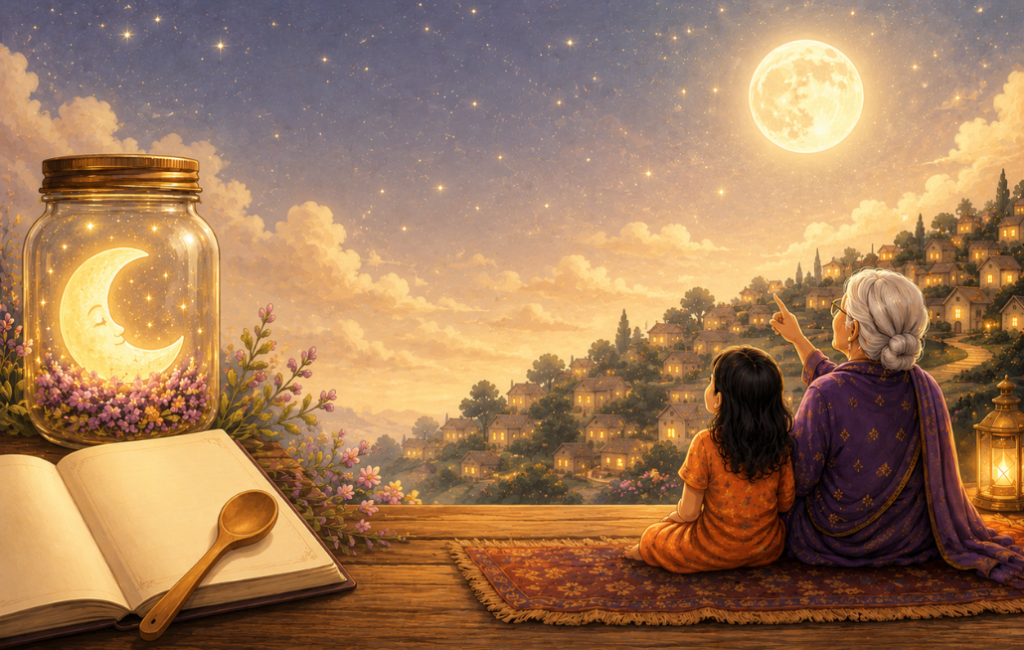
Priya finds a magical clay jar at her Dadi’s house that reveals forgotten family recipes, folk songs, and village traditions — but only under moonlight. The jar is cracking. She can only save three traditions before it breaks forever. Which will YOU choose?
Chapter 1The House That Smelled Like History
Priya did not want to go to her Dadi’s village.
She had said this very clearly, three times, with her arms crossed. Her phone had full signal at home in Delhi. There was a new cartoon dropping on Friday. And the village — Nandpur — had no Wi-Fi, no mall, and, as far as Priya was concerned, no point.
But her mother had simply picked up Priya’s bag, smiled the smile that meant “this is not a discussion,” and put her in the car.
Nandpur was a seven-hour drive. Priya spent the first three hours sulking, the next two sleeping, and the final two staring out the window as Delhi’s tall buildings melted into wide flat fields of mustard yellow and wheat gold, cut through by dirt roads and dotted with old peepal trees.
Dadi’s house was made of brick the colour of earth. Marigolds climbed the walls. The whole house smelled of something Priya couldn’t quite name — somewhere between old wood, fresh roti, and something sweet and smoky, like a story being told for the hundredth time.
Dadi herself was small, quick-eyed, and wore a dupatta the colour of the monsoon sky. She hugged Priya so tight that Priya could feel her own heartbeat slow down, just a little.
“Come,” said Dadi, taking her hand. “I have something to show you.”
🇮🇳 Did You Know? India Cultural Fact #1
India has over 700 distinct folk traditions, including art forms, songs, dances, and recipes — many of which exist only in small villages and are passed down through grandparents to grandchildren. When an elder passes away without sharing these traditions, they are lost forever.
🌕 Your First Choice
Dadi wants to show Priya something. But Priya still feels grumpy about missing her cartoon. What does she do? (You can change your choice anytime!)
✨ Beautiful choice! Priya chooses curiosity over grumpiness.
Priya decides that a whole week of sulking sounds exhausting. She squeezes Dadi’s hand and walks with her through a narrow corridor lined with old black-and-white photographs. She notices a woman in one photo who looks exactly like her — same nose, same stubborn chin. “Who is that?” she whispers. Dadi smiles and says nothing. Yet. 🌟
📱 Priya tries — even if her heart isn’t fully in it yet.
Priya shuffles along, holding her blank phone like a security blanket. But halfway down the corridor, she spots a tiny painted elephant on the wall — bright orange and blue, no bigger than her palm, its trunk curling upward for good luck. She stops. She has never seen anything so carefully made. Her phone slips into her pocket. Just for a moment, she tells herself. 🐘
🏃 Priya’s excitement takes over!
She sprints down the corridor, nearly knocking over an old brass pot. Dadi laughs — a big, warm sound Priya has never heard from her before. “Slow down, child! It’s waited 200 years. It can wait 2 more minutes.” Two hundred years? Priya’s feet stop all by themselves. 👀
Chapter 2The Jar Speaks
In the last room of the house — a small, cool room with a window facing east — sat the jar.
It was about as tall as a large watermelon, made of red-brown clay, with patterns pressed into it: a river, a tree, a woman grinding grain, a child chasing a kite. It was beautiful in the way that very old things are — not perfect, but deep.
“It belonged to your great-great-great grandmother,” said Dadi, sitting down on a low wooden stool beside it. “We call it the Moon Jar, because it only speaks under the light of the full moon.”
“Speaks?” Priya said. “Jars don’t speak, Dadi.”
Dadi smiled. “Not with words. With memories.”
That night, when the full moon rose over the peepal tree and its cold white light fell through the east window, the jar began to glow. Not brightly — softly, like a lamp behind paper. And from somewhere inside it, Priya heard the faint scent of something cooking, felt the thread of a melody she didn’t know but somehow recognised, saw flashes of images on its clay surface — women laughing around a fire, children learning to paint, old men teaching young ones to plough.
Priya sat on the floor, cross-legged, mouth open, for a very long time.
“What IS all this?” she finally whispered.
“Everything our family knew,” said Dadi quietly. “Everything we used to be.”
Family Recipes
Dishes cooked at festivals, monsoons and weddings — many using forgotten ingredients from the village fields.
Folk Songs
Songs sung at harvest, at births, at funerals — each carrying old wisdom like seeds in a cloth.
Village Arts
Patterns, paintings, embroideries — each symbol carrying meaning lost to modern eyes.
🇮🇳 Did You Know? India Cultural Fact #2
India has over 50 regional cuisines — and hundreds of hyper-local recipes that exist only within specific families or villages. Many are never written down. Once the elders who know them are gone, those flavours disappear from the world forever.
🌕 Your Second Choice
Dadi tells Priya she can learn from the Moon Jar all week. How should Priya spend her first full day? (You can change your choice anytime!)
🍲 Priya becomes a recipe collector!
Priya grabs a notebook and sits beside Dadi at the kitchen stove. Over the course of one extraordinary day, Dadi recites 11 recipes from memory — some that haven’t been cooked in 30 years. Priya writes every word in careful Hindi and then translates it herself. Her handwriting looks just like Dadi’s. She doesn’t notice until Dadi points it out. “Blood remembers,” says Dadi softly. 📖
🎨 Priya discovers she can draw!
She sits with the jar from sunrise to sunset, copying its patterns into her sketchbook. By evening, she has 14 drawings — each one a different symbol. When she shows them to Dadi, the old woman’s eyes fill with tears. “I have not seen these drawn by young hands in forty years,” she says. Priya realises she has a talent she never knew she had. ✏️
👵 Priya makes the wisest friends of her life!
She visits five elderly women in the village. Each one teaches her something different: one shows her how to make a ghungroo sound with dry seeds in a pot, one teaches her the name of every cloud in the village sky, one shows her a stitch pattern in embroidery that tells a whole story in a single line. Priya comes home with ten pages of notes and five invitations to come back tomorrow. 🌟
Chapter 3The Cracking Begins
On the fourth night, Priya heard it.
A sound like a knuckle cracking — sharp and small, from the direction of the east room.
She ran. Dadi followed.
The Moon Jar had a crack running down its right side. Not deep — not yet — but real, a thin dark line like a river on a map, running from the jar’s neck down to its belly.
Priya felt something drop in her chest.
“How long does it have?” she asked.
Dadi sat down slowly. “Three nights. Maybe four. Clay that is this old becomes fragile when it knows it is being watched too closely. It has been sleeping for decades. All this attention…” she sighed. “It is too much for it now.”
Priya looked at the jar. Inside it — she could sense it, she couldn’t explain how — were hundreds of traditions. Songs and recipes and dances and stories and planting wisdom and weather signs and lullabies and prayers. All of it held together in this one cracking piece of earth.
“We can’t save all of it, can we,” she said. It wasn’t a question.
Dadi shook her head. “We never could. Every generation saves what it can. The rest… becomes the past.”
“Then I choose,” said Priya. “I choose what we save.”
She sat down in front of the Moon Jar, folded her hands in her lap, and thought very hard about what mattered most.
🇮🇳 Did You Know? India Cultural Fact #3
UNESCO has listed 14 Indian traditions on its Intangible Cultural Heritage list — including Yoga, Kumbh Mela, and Chhau dance. But thousands of smaller, unnamed traditions exist only in living memory. Every day, some disappear quietly when their last keeper passes away.
Chapter 4One Last Moonlit Night
On the last night, the Moon Jar glowed brighter than it ever had before.
The crack had grown. Two more had joined it, thin as spider silk, running in different directions. Priya could see the moonlight coming through the cracks now, making patterns on the floor like scattered stars.
She sat beside Dadi. Her mother and father had come too — drawn in by something they couldn’t name, sitting cross-legged on the cool floor like children.
All of them watched as the jar offered, one last time, everything it held.
Images floated in the air above it: a grandmother teaching a granddaughter to roll rotis perfectly round. A young man learning to read weather by watching the legs of ants. A village coming together to build a well, singing the whole time. A little girl — who looked very much like Priya — learning a song she would teach her own children someday.
Priya caught her breath. That’s what roots feel like, she thought. Not a place. Not a language. Not even a recipe. It’s a thread. A golden thread running through everyone who has ever been in your family, all the way back to the beginning. And you are holding one end of it. And it is your job — not to grip it so tight it breaks — but to tie your piece to the next person, so it can keep going.
In the morning, the jar was still there — but silent. The glow was gone. The cracks had stopped spreading, as if it had finally exhaled and rested.
But what Priya had saved? That was alive. That would always be alive.
🌕 The Final Choice
The trip is ending. Priya has one last day in Nandpur. How does she honour what she has learned? (You can change your choice anytime!)
📓 The Heritage Book
Priya spends her last day filling a notebook with drawings, recipes, song fragments, and Dadi’s words. She decorates the cover with the Moon Jar’s patterns. Her mother frames the first page. Years later, Priya’s own daughter will find the book and ask: “Amma, who drew this?” And the thread will keep going. 🧵
👦👧 The Village Classroom
Fifteen children crowd into Dadi’s courtyard. Priya teaches three songs, two recipes, and one way to make a clay pot from river mud. The children teach her two things she didn’t know in return — the name of a local bird and the rules of a game played only in Nandpur. Heritage goes both ways, Priya realises. 🌍
🎙️ Dadi in Her Own Voice
Priya records 2 hours of Dadi speaking — her recipes, her memories, stories about Priya’s ancestors, a lullaby she sang to Priya’s father. Back in Delhi, Priya edits it into a short family documentary. Her uncle cries watching it. Her cousins ask for copies. Dadi’s voice will never be lost now. 🎬
🏺 Your Turn: Save 3 Traditions!
The Moon Jar can only hold 3 more traditions before it breaks. Which 3 will YOU choose to save? Click to select exactly 3, then tap the button.
Monsoon Roti Recipe
Made with seasonal herbs, cooked only when the first rain came.
Harvest Folk Song
Sung together by all families as they brought in the wheat every autumn.
Clay Wall Painting
Geometric patterns painted on home walls at festivals — each symbol had a meaning.
Ant Weather Reading
Village wisdom: reading approaching rain by watching how ants move.
The Moon Lullaby
A unique lullaby sung only in this family, passed mother to daughter for generations.
Seed Blessing Ritual
A ceremony performed before planting to thank the earth and ask for a good harvest.
Village Kite Festival
Held on the winter solstice — every family flew a kite with a wish tied to its tail.
Well-Building Song
The whole village would sing this song while digging a new well to keep spirits high.
🍲 Dadi’s Secret Recipes from the Moon Jar
The Moon Jar revealed two special recipes. Tap to switch between them!
🌕 Chandra Kheer (Moon Rice Pudding)
Traditionally made on full moon nights. Serves 4. Cooking time: 40 minutes.
Ingredients:
- 🥛 1 litre full-cream milk
- 🍚 3 tablespoons basmati rice (washed)
- 🍬 4 tablespoons sugar (or jaggery for the authentic taste)
- 🫙 3–4 green cardamom pods, crushed
- 🪷 1 teaspoon rose water
- 🥜 A small handful of chopped pistachios and almonds
- 🌸 A pinch of saffron dissolved in 1 tablespoon warm milk
Steps:
- Bring the milk to a gentle boil in a heavy-bottomed pot over medium flame. Stir continuously so it doesn’t stick.
- Add the washed rice and let it simmer on low heat, stirring every few minutes, for 25–30 minutes until the rice is very soft and the milk thickens.
- Add sugar and crushed cardamom. Stir well and cook for 5 more minutes.
- Remove from heat. Stir in the saffron milk and rose water.
- Pour into clay bowls. Garnish with nuts. Serve under the open sky if the moon is visible — as Dadi always did! 🌙
🟡 Dadi’s Til Laddoo (Sesame Sweet Balls)
Made at harvest festivals and winter celebrations. Makes ~15 laddoos.
Ingredients:
- 🌿 1 cup white sesame seeds (til), dry-roasted
- 🍯 ½ cup jaggery (gur), grated or roughly chopped
- 🥜 2 tablespoons roasted peanuts, coarsely crushed
- 💧 2 tablespoons water
- 🫙 A pinch of cardamom powder
- 🧈 A tiny bit of ghee for your hands
Steps:
- Dry-roast sesame seeds in a pan on low heat until they turn light golden and start to pop. Set aside to cool.
- In the same pan, add jaggery and water. Heat on low until the jaggery melts into a thick syrup. (Test: drop a tiny bit in cold water — if it forms a soft ball, it’s ready.)
- Add roasted sesame, peanuts, and cardamom to the syrup. Mix quickly off the heat.
- Grease your palms with a tiny bit of ghee. While the mixture is still warm (not hot!), quickly shape into round balls.
- Place on a plate and allow to cool fully before eating. Store in an airtight tin. 🏺
🎵 The Moon Jar’s Folk Song
The jar saved this song. Click to reveal it, one line at a time.
🧠 Quiz Time: What Did You Learn?
1. How many distinct folk traditions does India have?
2. What happens to a tradition when the last elder who knows it passes away without teaching it?
3. How many Indian traditions has UNESCO listed on its Intangible Cultural Heritage list?
4. In the story, WHY was the Moon Jar cracking?
🤝 Will You Be a Heritage Keeper?
Priya learned that saving culture doesn’t need a magical jar — it needs a listening heart and a willing pair of hands. Make YOUR pledge today. You can change it anytime!
🌟 Moral of the Story
Priya arrived in Nandpur wanting Wi-Fi. She left carrying something no internet connection could ever give her: a sense of where she came from, and who she was because of it.
Culture is not a museum exhibit. It is not something that only old people think about. It lives in the way your grandmother holds a spoon. In the tune she hums without realising. In the pattern she draws when she is thinking of nothing in particular.
And every time a child says “teach me,” the Moon Jar glows — just a little — and holds together for one more generation.
“You don’t have to remember everything. You just have to remember enough to pass it on.”