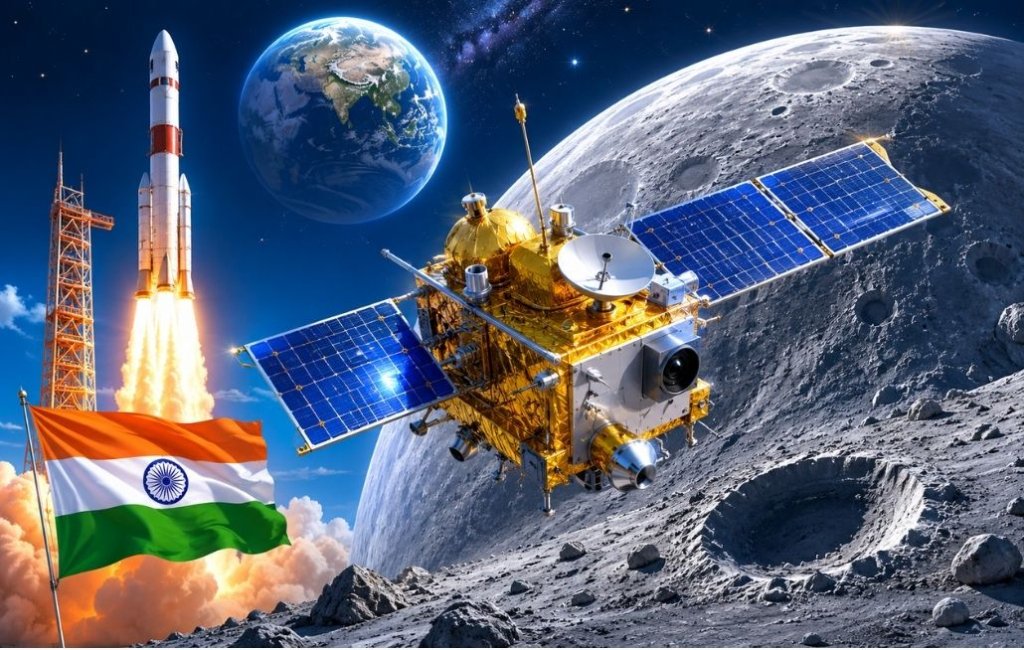
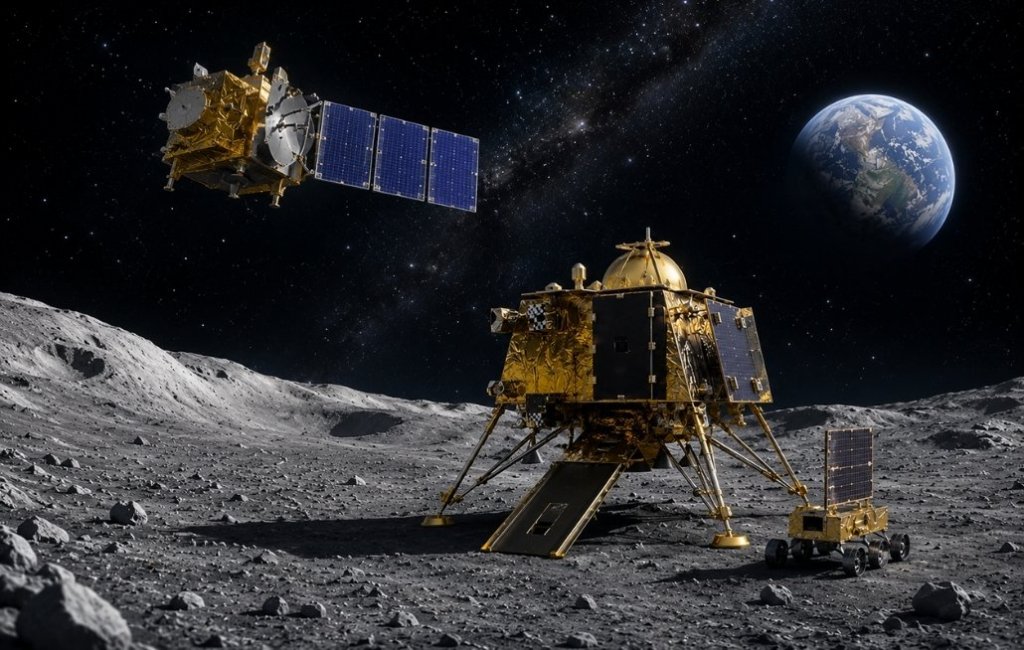
On July 22, 2019, India took another bold step in space exploration by launching Chandrayaan-2, its second mission to the Moon. Developed by the Indian Space Research Organisation (ISRO), the mission aimed to achieve something India had never done before—a soft landing on the Moon and the deployment of a robotic rover to explore its surface.
Although the Vikram lander lost communication during its final descent, Chandrayaan-2 was far from a failure. Its Orbiter continues to study the Moon, sending valuable scientific data that has improved our understanding of the lunar surface, minerals, and exosphere. More importantly, the lessons learned from Chandrayaan-2 became the foundation for the historic success of Chandrayaan-3.
| Mission Detail | Information |
|---|---|
| Mission Name | Chandrayaan-2 |
| Mission Type | Lunar Orbiter, Lander, and Rover Mission |
| Developed By | Indian Space Research Organisation (ISRO) |
| Launch Date | July 22, 2019 |
| Launch Location | Satish Dhawan Space Centre, Sriharikota, India |
| Launch Vehicle | GSLV Mk III-M1 (LVM3-M1) Rocket |
| Destination | Moon (South Polar Region) |
| Mission Objective | Demonstrate a soft landing, deploy a rover, and study the Moon’s surface, minerals, and exosphere |
| Spacecraft Weight | About 3,877 kg at launch |
| Mission Components | Orbiter, Vikram Lander, and Pragyan Rover |
| Lunar Orbit Reached | August 20, 2019 |
| Planned Landing Date | September 7, 2019 (IST) |
| Landing Site | Near the Moon’s South Polar Region |
| Major Instruments | Orbiter High Resolution Camera (OHRC), IIRS, DFSAR, CLASS, XSM, ChaSTE, ILSA, RAMBHA-LP, APXS, LIBS |
| Historic Achievement | First Indian mission to attempt a soft landing near the Moon’s South Pole |
| Scientific Discoveries | High-resolution lunar mapping, detection of elements, studies of water signatures, lunar exosphere, and surface composition |
| Mission Status | Orbiter Mission Successful; Lander Lost Communication During Landing |
| Orbiter Mission Life | Planned: 1 Year • Fuel Available for More Than 7 Years (initial estimate) |
In this blog, you’ll learn why Chandrayaan-2 was launched, how it traveled to the Moon, what happened during the landing attempt, the discoveries made by its Orbiter, and why the mission remains one of the most significant milestones in India’s journey toward becoming a global leader in space exploration.
What was Chandrayaan-2?
Chandrayaan-2 was India’s second lunar exploration mission, developed by the Indian Space Research Organisation (ISRO). Launched on July 22, 2019, the mission aimed to achieve India’s first soft landing on the Moon while studying the lunar surface, minerals, water signatures, and the Moon’s thin atmosphere. It was a major step forward in India’s space program, building upon the success of Chandrayaan-1 and introducing new technologies for landing and surface exploration.
Key Things to Remember About Chandrayaan-2:
- Chandrayaan-2 was India’s first mission that attempted a soft landing on the Moon.
- It was the first Indian mission to include an Orbiter, Lander, and Rover in a single spacecraft.
- Although the Vikram Lander lost communication during landing, the Orbiter continues to study the Moon successfully.
- The mission focused on exploring the Moon’s South Polar region, one of the least explored areas of the lunar surface.
- Chandrayaan-2 provided valuable scientific data and important engineering lessons that helped make Chandrayaan-3 a historic success.
Although the Vikram Lander lost communication during its final descent, the mission was far from unsuccessful. The Orbiter continues to orbit the Moon, collecting valuable scientific data and supporting lunar research. More importantly, Chandrayaan-2 provided the experience and technological improvements that helped ISRO achieve a successful soft landing with Chandrayaan-3, making it one of the most important missions in India’s space exploration journey.
Why Did ISRO Launch Chandrayaan-2?
After the success of Chandrayaan-1, ISRO wanted to take India’s lunar exploration program to the next level. Instead of only studying the Moon from orbit, Chandrayaan-2 was designed to land on the lunar surface, deploy a robotic rover, and carry out scientific experiments directly on the Moon. The mission also aimed to strengthen India’s space technology and contribute valuable scientific knowledge to the global space community.
Soft Moon Landing
Attempt India’s first controlled soft landing on the Moon and operate a rover on its surface.
Scientific Research
Study the Moon’s surface, minerals, water signatures, and thin atmosphere using advanced instruments.
Explore the South Pole
Investigate the Moon’s South Polar region, an area believed to contain water ice and valuable scientific clues.
Develop New Technology
Test India’s landing, navigation, communication, and rover technologies for future space missions.
Support Global Science
Collect accurate lunar data that could help scientists around the world better understand the Moon.
Strengthen India’s Space Program
Prepare ISRO for more advanced lunar missions and future human space exploration.
Chandrayaan-2 was much more than a mission to reach the Moon. It represented India’s ambition to master advanced space technologies, expand scientific knowledge, and explore one of the Moon’s most mysterious regions. Although the landing did not go exactly as planned, the mission achieved many of its scientific goals and laid the foundation for the remarkable success of Chandrayaan-3, proving that every mission is an opportunity to learn and move forward.
What Were the Mission Objectives of Chandrayaan-2?
Chandrayaan-2 was designed with clear scientific and technological goals that would take India’s lunar exploration to the next level. Unlike its predecessor, this mission aimed not only to study the Moon from orbit but also to attempt a soft landing and explore the lunar surface using a robotic rover. These objectives helped ISRO improve its space technology while contributing valuable knowledge about one of the Moon’s least explored regions.
- Soft Landing
Safely land the Vikram Lander on the Moon’s South Polar region and demonstrate India’s soft-landing capability. - Rover Exploration
Deploy the Pragyan Rover to move across the lunar surface and perform scientific experiments. - Scientific Research
Study the Moon’s surface, minerals, chemical composition, and exosphere using advanced scientific instruments. - Search for Water
Investigate the presence and distribution of water molecules and water ice, especially near the Moon’s South Pole. - Technology Demonstration
Test and validate new technologies for landing, navigation, communication, and rover mobility for future missions. - Expand Lunar Knowledge
Collect accurate scientific data to help researchers better understand the Moon’s origin, evolution, and environment.
Together, these objectives made Chandrayaan-2 one of ISRO’s most ambitious space missions. While the lander could not complete its planned touchdown, the successful Orbiter continues to achieve many of these goals, providing valuable scientific discoveries and paving the way for the historic success of Chandrayaan-3.
How Did Chandrayaan-2 Reach the Moon?
Reaching the Moon is not as simple as launching a spacecraft straight into space. Chandrayaan-2 followed a carefully planned journey that lasted about four weeks, using Earth’s gravity and a series of orbit-raising maneuvers to save fuel before entering the Moon’s orbit. Every stage of the mission was precisely calculated to ensure the spacecraft reached its destination safely.
Follow the timeline below to understand how Chandrayaan-2 traveled from Earth to the Moon.
Chandrayaan-2: Mission Timeline
Chandrayaan-2 was launched aboard the GSLV Mk III-M1 rocket from the Satish Dhawan Space Centre in Sriharikota, India.
The spacecraft completed multiple Earth orbits while gradually increasing its altitude before leaving Earth’s gravitational pull.
ISRO carried out the Trans Lunar Injection (TLI) maneuver, sending Chandrayaan-2 toward the Moon.
After traveling nearly 384,000 km, the spacecraft entered lunar orbit and began lowering its altitude.
The Vikram Lander, carrying the Pragyan Rover, separated from the Orbiter for its landing attempt.
Vikram began its descent toward the Moon’s South Pole, but communication was lost during the final stage of landing.
The Orbiter continues studying the Moon, sending valuable scientific data that supports lunar research and future missions.
The journey of Chandrayaan-2 demonstrated ISRO’s growing expertise in deep-space navigation and lunar exploration. While the landing attempt faced challenges, the mission successfully placed a powerful Orbiter around the Moon, proving India’s technological capabilities and providing valuable experience that helped make Chandrayaan-3 a historic success.
What Are the Orbiter, Vikram, and Pragyan?
One of the biggest differences between Chandrayaan-1 and Chandrayaan-2 was its advanced mission design. Instead of sending just one spacecraft, ISRO built three different components that worked together to explore the Moon from orbit and on its surface.
Each component had a unique role. The Orbiter studied the Moon from space, the Vikram Lander attempted a soft landing, and the Pragyan Rover was designed to move across the lunar surface and conduct scientific experiments.
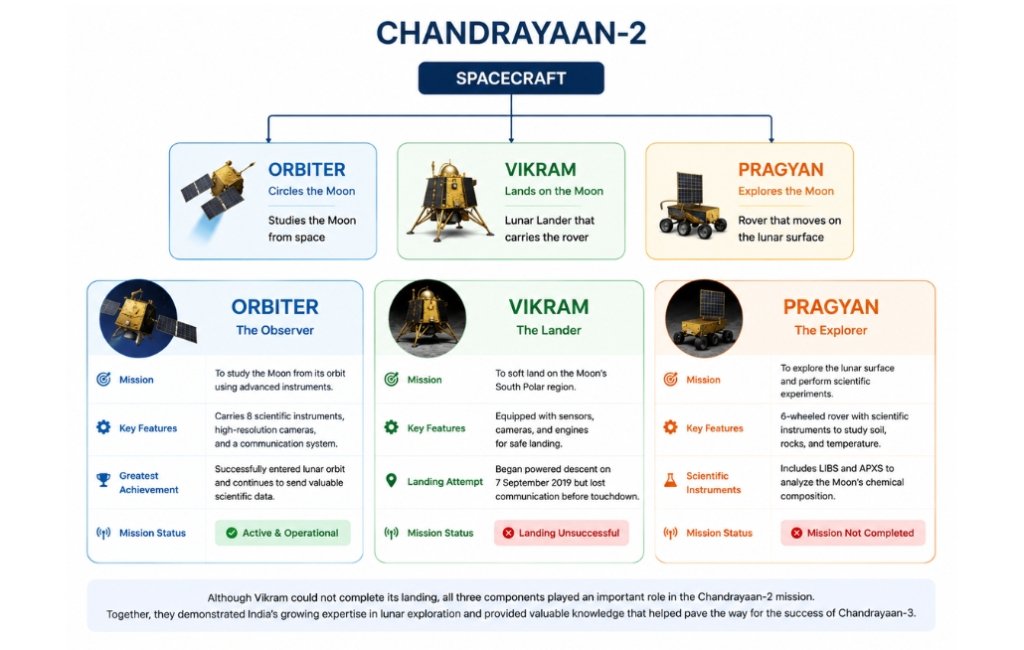
Although Vikram could not complete its landing, all three components played an important role in the Chandrayaan-2 mission. Together, they demonstrated India’s growing expertise in lunar exploration and provided valuable knowledge that helped pave the way for the success of Chandrayaan-3.
Why Did the Vikram Lander Lose Contact?
On September 7, 2019, millions of people around the world watched as the Vikram Lander began its final descent toward the Moon’s South Polar region. The landing was progressing as planned until the last few minutes, when communication between the lander and ISRO’s mission control was suddenly lost. Although the landing could not be completed successfully, the mission provided valuable engineering lessons that helped ISRO achieve a successful lunar landing with Chandrayaan-3.
What Happened During the Landing of Chandrayaan-2?
📍 Powered Descent Began
Vikram started reducing its speed using onboard engines as it descended toward the Moon’s surface.
⚙️ Automatic Navigation
The lander used cameras, sensors, and onboard computers to determine its position and adjust its landing path.
🚨 Unexpected Deviation
During the final stage of descent, the lander deviated from its planned trajectory and its speed increased beyond the expected limits.
📡 Communication Lost
When Vikram was only a short distance above the lunar surface, communication with ISRO’s ground station was lost.
🔍 Investigation Conducted
A detailed analysis found that the lander’s guidance and control system could not recover from the unexpected deviation during the final descent.
🚀 Lessons for the Future
The findings helped ISRO improve its landing software, sensors, and engineering systems, leading to the successful landing of Chandrayaan-3 in 2023.
Key Facts to Remember:
- Vikram successfully completed most phases of its journey before the final descent.
- Communication was lost only during the last stage of the landing.
- The Orbiter remained fully operational and continued its scientific mission.
- The experience gained from Chandrayaan-2 directly improved the design and landing strategy of Chandrayaan-3.
Although Vikram could not complete its soft landing, Chandrayaan-2 was far from a failure. The mission demonstrated India’s advanced space capabilities, provided valuable scientific data through the Orbiter, and gave ISRO the knowledge needed to achieve the historic success of Chandrayaan-3. In space exploration, every mission contributes valuable lessons, and Chandrayaan-2 proved that setbacks can become the foundation for future achievements.
What Did Chandrayaan-2 Discover on the Moon?
Although the Vikram Lander could not complete its mission, the Chandrayaan-2 Orbiter has been an outstanding success. Equipped with advanced scientific instruments, it has been continuously studying the Moon from orbit, collecting valuable information about its surface, minerals, water signatures, and extremely thin atmosphere. These discoveries have improved our understanding of the Moon and continue to support lunar research around the world.
Water Signatures
The Orbiter mapped water and hydroxyl signatures across different regions of the Moon, helping scientists understand how water is distributed.
Surface Minerals
High-resolution observations revealed the composition of lunar rocks and minerals, providing clues about the Moon’s geological history.
Detailed Mapping
The Orbiter produced highly detailed images of craters, mountains, valleys, and other lunar surface features.
Lunar Exosphere
Scientists studied the Moon’s extremely thin atmosphere to better understand its composition and how it changes over time.
Polar Research
Chandrayaan-2 collected valuable data from the Moon’s South Polar region, one of the least explored places on the lunar surface.
Future Missions
The scientific data collected by the Orbiter continues to support new lunar research and future exploration missions.
The Chandrayaan-2 Orbiter proved that the mission was a remarkable scientific success. Its discoveries have expanded our understanding of the Moon’s surface, water distribution, minerals, and environment. Even years after its launch, the Orbiter continues to send valuable data, making Chandrayaan-2 one of ISRO’s most productive lunar missions and an important milestone in global space research.
Was Chandrayaan-2 a Success or a Failure?
Many people believe that Chandrayaan-2 was a failure because the Vikram Lander lost communication during its final descent to the Moon. However, this is only part of the story. While the landing attempt did not go as planned, the mission achieved many of its major scientific objectives. The Orbiter successfully entered lunar orbit and continues to study the Moon, making Chandrayaan-2 one of ISRO’s most valuable space missions.
Instead of asking whether Chandrayaan-2 was a success or a failure, it is more accurate to understand what succeeded and what did not. The table below provides a clear comparison.
Chandrayaan-2: Success vs. Challenge
| Mission Component | Result | Status |
|---|---|---|
| 🚀 Launch | Successfully launched from Sriharikota on July 22, 2019 | ✅ Success |
| 🌕 Lunar Orbit | Successfully entered the Moon’s orbit | ✅ Success |
| 🛰️ Orbiter Mission | Continues to study the Moon and send scientific data | ✅ Success |
| 🔬 Scientific Research | Produced valuable discoveries about the Moon’s surface, minerals, water signatures, and exosphere | ✅ Success |
| 📍 Vikram Landing | Communication was lost during the final stage of landing | ⚠️ Partial Success |
| 🤖 Pragyan Rover | Could not be deployed because the lander did not complete a soft landing | ❌ Not Completed |
| 🚀 Future Missions | Engineering lessons directly contributed to the successful Chandrayaan-3 mission | ✅ Success |
Why Scientists Still Consider Chandrayaan-2 a Success:
✅ The Orbiter remains operational and continues to return valuable scientific data.
✅ ISRO successfully demonstrated advanced deep-space navigation and lunar orbit insertion.
✅ The mission improved India’s landing technologies and mission planning.
✅ Engineers identified the causes of the landing issue and corrected them for Chandrayaan-3.
✅ Chandrayaan-2 strengthened India’s position as one of the world’s leading spacefaring nations.
Although the Vikram Lander could not complete its soft landing, Chandrayaan-2 was far from a failure. Its successful Orbiter continues to expand our knowledge of the Moon, while the lessons learned from the landing attempt helped ISRO achieve the historic success of Chandrayaan-3. In space exploration, every mission adds to scientific understanding, and Chandrayaan-2 proved that even challenges can become stepping stones toward greater achievements.
How Did Chandrayaan-2 Lead to Chandrayaan-3?
Although Chandrayaan-2 did not achieve a successful soft landing, it provided ISRO with valuable engineering experience. By carefully analyzing the Vikram lander’s final descent, scientists identified the challenges and improved the mission’s software, sensors, navigation system, and landing strategy.
These improvements became the foundation of Chandrayaan-3, which successfully landed near the Moon’s South Polar region on August 23, 2023. Chandrayaan-2 proved that every challenge is an opportunity to learn, making it a crucial stepping stone in India’s successful journey of lunar exploration.
FAQ About Chandrayaan-2
1. When was Chandrayaan-2 launched?
Answer: Chandrayaan-2 was launched on July 22, 2019, from the Satish Dhawan Space Centre in Sriharikota, Andhra Pradesh, using the GSLV Mk III-M1 (LVM3-M1) launch vehicle.
2. How long did Chandrayaan-2 take to reach the Moon?
Answer: Chandrayaan-2 took about 29 days to reach the Moon. It entered lunar orbit on August 20, 2019, after performing several orbit-raising maneuvers around Earth.
3. Why did ISRO choose the Moon’s South Polar region?
Answer: The South Polar region is believed to contain water ice in permanently shadowed craters. It is also one of the least explored parts of the Moon, making it an ideal location for scientific research and future lunar missions.
4. How many scientific instruments were carried by Chandrayaan-2?
Answer: Chandrayaan-2 carried 14 scientific instruments across its Orbiter, Vikram Lander, and Pragyan Rover. These instruments were designed to study the Moon’s surface, minerals, exosphere, and elemental composition.
5. Is the Chandrayaan-2 Orbiter still working?
Answer: Yes. The Orbiter remains operational and continues to send valuable scientific data about the Moon. It has exceeded its original planned mission life and is still supporting lunar research.
6. What was the biggest challenge faced by Chandrayaan-2?
Answer: The biggest challenge occurred during the final stage of the Vikram lander’s descent, when communication with the lander was lost before it could complete a soft landing on the Moon.
7. Did Chandrayaan-2 discover water on the Moon?
Answer: Chandrayaan-2 continued studying the Moon’s water signatures and improved scientists’ understanding of how water is distributed across the lunar surface. However, the first direct confirmation of water molecules on the Moon was made by Chandrayaan-1.
8. What happened to the Pragyan Rover?
Answer: The Pragyan Rover was carried inside the Vikram Lander. Since the lander could not complete its soft landing, the rover was never deployed onto the Moon’s surface.
9. How did Chandrayaan-2 help future space missions?
Answer: The mission provided valuable lessons in landing technology, navigation, software, and spacecraft design. These improvements were successfully applied in Chandrayaan-3, which achieved India’s first soft landing on the Moon.
10. Why is Chandrayaan-2 considered an important mission?
Answer: Chandrayaan-2 demonstrated India’s growing expertise in lunar exploration, advanced spacecraft technology, and deep-space missions. Despite the landing setback, its successful Orbiter continues to make important scientific contributions, making the mission a major milestone in India’s space program.
Final Thought
Chandrayaan-2 was more than just India’s second mission to the Moon – it was a mission of ambition, innovation, and learning. While the Vikram lander’s landing did not go as planned, the successful Orbiter continues to expand our understanding of the Moon, and the lessons learned became the foundation for the historic success of Chandrayaan-3. Chandrayaan-2 reminds us that in science, every challenge brings new knowledge, and every mission moves humanity one step closer to understanding the universe.