

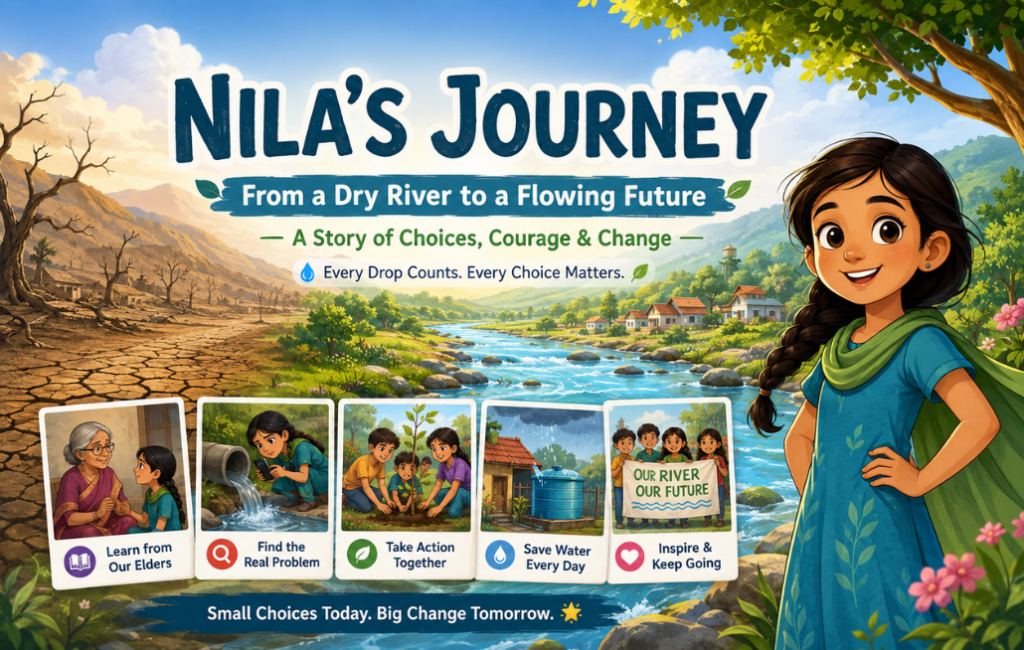
An interactive water conservation story where YOUR choices shape the ending!
📜 Before You Begin…
This is not an ordinary story – it’s YOUR story too! As you read, you’ll make choices for Nila, answer quiz questions, and help sort water habits at the end. Ready? Let’s go! 💧
🌅 Chapter 1 – The River That Went Silent
Ten-year-old Nila woke up every morning to the sound of the Shikara River singing outside her window. The river wasn’t just water – it was the heartbeat of Kunjal Village. Farmers used it to water their crops. Children played in its cool, shimmering pools. Grandmothers collected it in clay pots and said it tasted like the sweetest story ever told.
But one Tuesday morning, Nila woke up and heard… nothing.
She ran to the window. The river hadn’t stopped completely – but it looked sick. The water was thin, brown, and slow. The stones on the riverbed that were normally hidden were now sticking out like dry bones. A dead fish floated near the bank.
“What happened to the river, Amma?” Nila asked her mother at breakfast.
Her mother sighed. “People say it started two monsoons ago. Less rain, more people wasting water. And then that factory opened upstream…” She stirred her chai slowly, her eyes distant. “I don’t know, Nila. I just don’t know.“
Nila looked at her half-full glass of water. She thought about how she always left the tap running while brushing her teeth. She thought about the long showers she loved. A lump of guilt settled in her stomach.
She made a quiet decision: she was going to save the river. But how?
🌍 Did You Know? Water Fact #1
Only 3% of Earth’s water is freshwater – and most of that is frozen in glaciers! Less than 1% is available for all the humans, animals, and plants on land. Every drop truly matters.
🤔 Your First Big Decision
🌿 Chapter 2 – The Meeting Under the Banyan Tree
Word spread through Kunjal Village. Nila – a 10-year-old girl – was asking big questions about the river. Some adults laughed. Some rolled their eyes. But many listened.
On Saturday evening, Nila stood on an overturned crate under the old banyan tree in the village square. Twenty adults, thirty children, and even the headmaster of her school had gathered. She was terrified. Her knees felt like boiled noodles.
She took a deep breath and spoke.
“Our river is sick. But WE made it sick – and WE can make it well again. I found out three things: the factory upstream is pouring dirty water into the river. Our village uses 200 litres more water per day than we need. And we stopped collecting rainwater 15 years ago.“
There was a long silence.
Then old Dadi Kamla stood up, her walking stick tapping the ground. “The child is right. I am ashamed it took a 10-year-old to say what I should have said years ago.“
The headmaster raised his hand. “Nila, what do you want us to do?“
Nila felt the weight of everyone’s eyes. She had three ideas. Which one was most important to do RIGHT NOW?
🌍 Did You Know? Water Fact #2
The average person uses about 135 litres of water per day. Simply turning off the tap while brushing teeth saves up to 12 litres every single time! Small habits, massive difference.
🤔 Nila’s Second Decision
☀️ Chapter 3 – Three Months Later
Three months had passed since that meeting under the banyan tree. And the river – oh, the river! – was waking up.
It wasn’t dancing yet, not like in old photographs. But the water was clearer. There were three small fish near the bank (Nila named them Raju, Cheenu, and Bubbles). The smell of grey factory water was gone. And last week, after a good rain, the river had actually risen six whole centimetres. The village had measured it with a stick they stuck in the mud – and celebrated with ladoo from old Ramu’s sweet shop.
Nila sat by the river after school, her feet in the cool water. A frog jumped onto her knee, stared at her with huge eyes, and jumped off again. She laughed.
Her friend Aryan sat beside her. “You did this, Nila,” he said.
“WE did this,” she said firmly. “All of us. Even Bubbles helped.”
She looked at the river. There is still so much work to do, she thought. The river needed more trees on its banks. The village needed to keep checking the factory. Children needed to keep saving water every single day.
But today? Today, the river was singing again. Just a little. And a little is how great things begin.
🌍 Did You Know? Water Fact #3
Trees are water protectors! A single mature tree can absorb up to 450 litres of water from the soil and release it slowly, keeping rivers and lakes healthy. That’s why cutting trees causes rivers to dry up!
🤔 The Final Decision
🧠 Quiz Time!
[ays_quiz id=’12’]
🎮 Drag & Drop Activity!
🤝 Will YOU Be a Water Guardian?
🌟 Moral of the Story
Nila was just one 10-year-old girl. She didn’t have money, power, or a magic wand. What she had was curiosity, courage, and care. She asked questions, took action, and inspired a whole village.
Water is not just a resource – it is life itself. And protecting it is not just a government job or a scientist’s job. It is everyone’s job. Including yours.
“The river doesn’t ask who is important enough to drink from it. Neither should we ask who is important enough to save it.“